


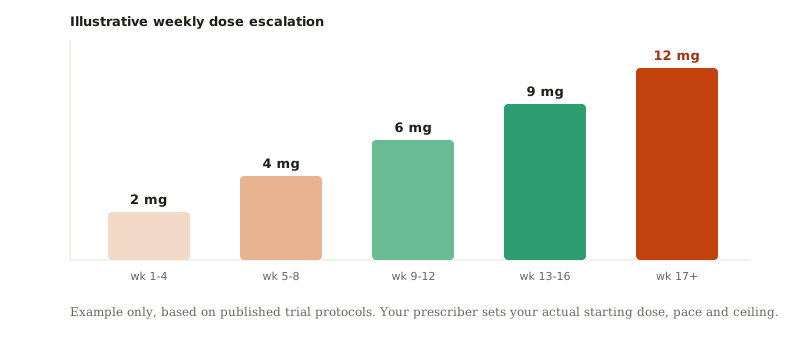
To grasp retatrutide dosage, begin here: it is an investigational compounded peptide, and the proper amount for any person is determined by a licensed prescriber, not a chart. Retatrutide has not been approved by the FDA. This page describes how retatrutide dosing is typically organized in clinical studies and by telehealth services, why the stepwise increase matters, and how a milligram prescription translates into the 'units' you read on a syringe. Treat this as educational material, not personalized medical advice. Your clinician determines your starting dose, the rate of increase, and the upper limit.
Essential facts about retatrutide dosing
- Given as a subcutaneous injection once per week on the same day.
- Trials generally began with a low dose (often around 2 mg weekly) and escalated monthly.
- Research protocols studied maintenance doses up to approximately 8 mg and 12 mg per week.
- The milligram quantity is set by your physician; syringe 'units' vary based on how the compound was formulated.
- Retatrutide is investigational and compounded, and it requires a prescription.
Starting dose of retatrutide and why slow titration is used
A cautious initial amount is mainly because of the gastrointestinal system. Retatrutide acts on GLP-1, GIP, and glucagon receptors, and the GLP-1 portion is particularly associated with nausea, reflux, and other digestive side effects when the body encounters a new dose too quickly. A stepwise increase lets the digestive tract adjust, often reducing the severity and making these effects easier to handle.
In clinical trials, participants typically started at about 2 mg weekly and remained there for four weeks before any increase. Some telehealth plans begin at even lower doses. The aim of a slow schedule is not to reach high amounts quickly; it is to find the smallest dose that works and is well tolerated. Not everyone needs the highest dose studied.
An example retatrutide dose escalation table
The following retatrutide dosage plan is a representative schedule based on how trials and many compounding-pharmacy protocols carry out a gradual monthly increase. This is only an example and not a prescription; it does not indicate what you should take. Your clinician will create your personalized retatrutide dosing plan based on your responses, tolerance, and goals.
| Weeks | Dose (mg/week) | Notes |
|---|---|---|
| 1–4 | 2 mg | Initial phase while the body adjusts to the peptide. |
| 5–8 | 4 mg | First step up if the starting dose is well tolerated. |
| 9–12 | 6 mg | Some people achieve their effective maintenance amount at this level. |
| 13–16 | 8 mg | Higher maintenance dosage range evaluated in studies. |
| 17+ | up to 12 mg | Maximum research dosage range; considered only if your clinician finds it necessary. |
What dose of retatrutide is appropriate for me?
No single dosage fits everyone. The simple answer is that your dose is what your prescriber decides after reviewing your medical history, other medications, and your initial response over several weeks. Two people of similar body weight may need very different maintenance doses. To see a possible titration pattern, our retatrutide dosage calculator You can sketch out a possible plan to discuss with your clinician—this does not replace their professional judgment.
How retatrutide is measured in units versus milligrams
This is the point where confusion most often arises. Milligrams are what your prescriber specifies, while an insulin-style syringe is marked in units. Those units represent volumea measure of volume rather than the drug's quantity: with a standard U-100 syringe, 1 mL is the same as 100 units. Therefore a 4 mg dose may translate into a widely different unit count depending on the strength of your vial, which is established during reconstitution.
Before any of this matters, the lyophilized powder must be reconstituted. Consult our walkthrough on reconstituting your vial with bacteriostatic water for the precise steps—how much water you add sets the concentration, and therefore the retatrutide dose expressed in mL and units.
Example dose conversion table
The table below illustrates how a fixed vial strength translates into units when the water volume changes. These examples exist only to demonstrate the calculation, not to serve as instructions for your own vial.
| Vial | BAC water added | Concentration | 2 mg dose | 4 mg dose |
|---|---|---|---|---|
| 10 mg | 1 mL | 10 mg/mL | 0.20 mL = 20 units | 0.40 mL = 40 units |
| 10 mg | 2 mL | 5 mg/mL | 0.40 mL = 40 units | 0.80 mL = 80 units |
| 30 mg | 3 mL | 10 mg/mL | 0.20 mL = 20 units | 0.40 mL = 40 units |
Guidelines for taking retatrutide safely
Once mixed, the medicine is injected subcutaneously into the abdomen, thigh, or upper arm. For correct technique—rotating injection sites, clearing bubbles, needle angle—see our guide on how to inject retatrutideNever share pens, needles, or vials, and store the vial as directed by your pharmacist.
How often to dose, if you miss a dose, and long-term use
Why retatrutide is given once a week
Retatrutide has an extended half-life of roughly six days, based on early research. A once-weekly injection keeps blood levels relatively steady between doses without the need for daily shots, which is why most retatrutide schedules settle on one fixed day each week.
Pick a consistent day
Choose a single day of the week and keep to it. A steady interval supports stable levels and makes a missed dose easier to spot.
Handle a missed dose appropriately
Many plans suggest that if you remember within roughly 1–2 days, you can take it and then resume your normal schedule; if the next dose is close, skip it and carry on. Never take a double dose. Follow whatever your clinician advised.
Hold at a maintenance dose
If you reach a dose that works well and produces only mild side effects, you can remain at that level rather than escalating to the highest one. The aim is to use the smallest amount that remains effective.
Maintenance vs maximum dose
Maintenance and maximum aren't the same concept. The highest studied weekly retatrutide dose shown on the chart above marks the top end, yet after weight and appetite have leveled off, the majority of users continue on a smaller maintenance dose. Chasing the top dose seldom improves outcomes and frequently increases adverse effects.
Not sure where to begin for a safe, medically supervised protocol? Complete the intake questions, and a licensed clinician will assess whether you qualify.
Get startedWhen your clinician adjusts your dose
There is no one-size-fits-all retatrutide dosing schedule. If nausea or other side effects become hard to tolerate, if weight is dropping so fast that it warrants monitoring, or if new health concerns arise, doctors frequently reduce, hold, or postpone a dose increase. Rather than escalating on schedule, they may keep you at the same step for another month. They might also stop increasing the dose early when you are responding well. Always show up for check-ins, be candid about side effects, and never self-adjust your dose to compensate for a missed one. To see what a realistic response looks like in the first months, refer to our weight-loss timeline.
Retatrutide dosage FAQ
What is a typical starting dose for retatrutide?
In many studies and treatment protocols, the starting point is roughly 2 mg once weekly, maintained for about four weeks before any escalation. Certain telehealth programs begin at a lower amount. Your physician determines your actual initial dose.
How do I convert my retatrutide dose from milligrams to units?
Units express volume, which varies with concentration. To calculate mL, divide your dose in milligrams by the concentration in mg/mL. Then multiply that figure by 100 to obtain the number of units on a U-100 syringe. Confirm with your pharmacy.
What is the maximum weekly dose of retatrutide?
In research settings, maintenance targets reached approximately 8 mg and 12 mg per week, but the majority of individuals stay on a lower maintenance dose. The maximum is not a goal to pursue.
What should I do if I miss a weekly dose?
Generally, you can take the missed dose if it is within about 1–2 days, then resume your usual schedule. If your next dose is coming up soon, you may skip the missed one. Never take two doses at the same time, and always adhere to your doctor's specific instructions.
Is there an official dosing chart for retatrutide?
No. Because retatrutide is still under investigation and has not received FDA approval, no official chart appears in the label. Any chart, including the one on this page, serves only as an example to discuss with a licensed prescriber.
Can I follow a dosing chart I found online?
No. Charts vary based on vial strength and how the peptide is reconstituted, and self-dosing is risky. Use only the dose and concentration that your clinician and pharmacy have verified for your specific vial.
Research-grade · COA per lot