


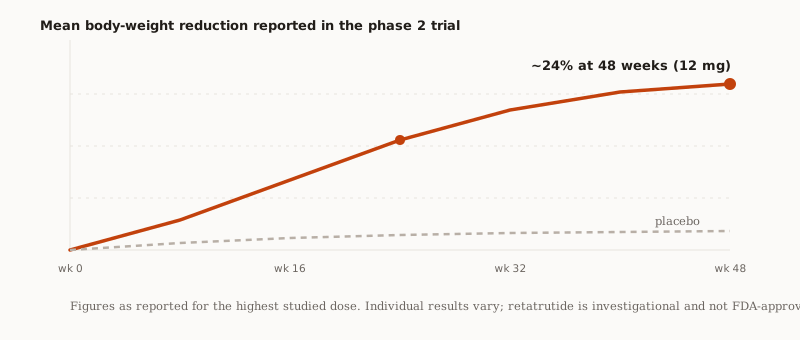
Interest in retatrutide and bodybuilding has grown rapidly in online searches, yet a widespread misunderstanding fuels much of that attention and should be clarified right away: retatrutide is not an anabolic compound. It is an investigational peptide acting on three receptors (GLP-1, GIP, and glucagon) and is under study for weight reduction. Its mode of action does not stimulate muscle growth. Rather, it lowers body weight, and substantial weight loss from any cause necessarily brings some loss of lean mass alongside fat. That trade-off is what this page primarily addresses.
Quick orientation: No FDA approval exists for retatrutide in any indication. Within the United States, it can only be obtained as a compounded product via prescription from a licensed healthcare provider. It has never been approved, researched, or promoted for athletic performance, physique enhancement, or bodybuilding. Nothing here constitutes a protocol or an endorsement of off-label use.
If you are asking whether retatrutide can help you get leaner while keeping your muscle, the direct answer comes in two parts. It can substantially lower fat mass. But it will not build muscle, and unless you make a deliberate effort, you will probably lose some. The rest of this page covers the reasons why and what the evidence indicates you can do about it.
Does retatrutide build muscle? The short answer
No. Retatrutide has no pathway through which it could boost muscle protein synthesis. Its three receptor targets affect appetite, gastric emptying, insulin secretion, and liver energy metabolism—processes that reduce calorie intake and raise energy expenditure. None of them engage the androgen receptor, growth hormone pathways, or the mechanical tension signaling that actually stimulates muscle growth.
Is it possible to build muscle while taking retatrutide?
In theory, yes, but only because of your own training, not the drug itself. Building muscle in a calorie deficit is possible under certain circumstances: beginners to resistance training, those coming back after a long layoff, and people carrying a lot of excess body fat. These groups may achieve body recomposition, gaining lean tissue while shedding fat. A seasoned lifter near their genetic ceiling, in a deep deficit and using an appetite suppressant, does not match that profile. For them, the realistic goal is preservation rather than gain.
Why the glucagon component is not an anabolic signal
Retatrutide's glucagon receptor activity distinguishes it from dual or single agonists and is thought to drive greater energy expenditure and effects on liver fat. 'Increased energy expenditure' is sometimes misunderstood online as a metabolic edge for bodybuilding. That is wrong. Burning more calories at rest aids fat loss, not muscle gain, and glucagon signaling in the liver has no established role in skeletal muscle hypertrophy.
What 'lean mass' truly means in body composition scans
Conversations about retatrutide's effect on muscle often go astray because of definitional confusion. When a DEXA scan or bioimpedance device shows a drop in 'lean mass,' that number does not measure muscle specifically. Fat-free mass includes several components that predictably fall during weight loss and have nothing to do with contractile tissue.
The first components to decrease
Muscle stores glycogen, and each gram of glycogen is bound to roughly three grams of water. When carbohydrate intake falls—which often happens with reduced appetite—glycogen and its associated water are lost quickly. Total body water also declines as food and sodium intake drop. In addition, sustained weight loss reduces connective tissue, blood volume, and even organ mass that once supported a larger body. All these shifts appear as lost lean mass on a scan.
This has practical implications: a scan taken two weeks into treatment may show an alarming drop in lean mass that is mostly water and glycogen. Re-scanning after weight has stabilized and hydration is consistent gives a more reliable assessment than a single early measurement.
What trial data revealed about body composition
Body composition sub-analyses from retatrutide's obesity trials showed that a significant portion of total weight loss was fat mass, while a smaller proportion was fat-free mass. This is broadly in line with findings for other incretin-based drugs and typical dietary weight loss. These were secondary outcomes in a subset of participants, measured over a defined period, and should be viewed as indicative rather than a guarantee for any individual. We deliberately avoid citing exact percentages because figures circulating in forums are often misattributed or based on studies of different medications. Consult a qualified clinician for accurate published data. Our overview of weight-loss results provides more details on the primary endpoints.
Does retatrutide cause muscle loss, or is it the calorie deficit?
This is a critical distinction often overlooked. There is no evidence that retatrutide directly breaks down skeletal muscle. Its primary effect is appetite suppression, which paradoxically makes two key muscle-preserving behaviors more challenging to maintain.
The protein problem
Protein is the most satiating macronutrient, which is beneficial when trying to eat less, but it becomes a hurdle when you need to meet protein targets despite a diminished appetite. Many individuals on incretin therapy find meat less appealing, and delayed gastric emptying makes large meals uncomfortable. As a result, protein intake often drops proportionally with total calories, or even faster. Inadequate protein during a calorie deficit is a well-established contributor to lean tissue loss.
The training problem
The second factor is the lack of a stimulus that signals the body to retain muscle. Resistance training provides that signal. Without it, the body has no metabolic incentive to maintain costly tissue. Fatigue, nausea, or low energy during the initial weeks—see our page on nausea and other common effects —can cause training to fall by the wayside precisely when it is most crucial.
In the reported studies, strength and functional capacity changes were evaluated as trial endpoints rather than self-assessed by patients.
Common questions about retatrutide and muscle mass
Is retatrutide capable of supporting muscle growth?
No, it lacks anabolic activity. Anecdotally, some individuals report feeling stronger relative to their body weight following fat loss, which can improve performance in bodyweight movements, yet this stems from carrying less weight, not from additional muscle.
Does retatrutide preserve muscle better than other weight-loss drugs?
No head-to-head studies exist to back up that claim. Body composition changes with incretin-based therapies have generally been similar, and comparisons made online do not come from clinical trials designed to answer this question.
How much protein should be consumed while on treatment?
This is an individual medical decision. During weight loss, protein needs per kilogram of body weight are usually greater than during weight maintenance, but the precise amount hinges on your muscle mass, kidney function, and other variables. A physician or registered dietitian can help you set the right target.
After stopping treatment, will lost lean mass be regained?
Weight regain after discontinuation typically involves both fat and lean tissue, but the composition regained is often worse than what was lost, particularly without resistance training. Following treatment, sticking to a training program and getting enough protein are the main factors within your control.
Can I train at high intensity while my dose is being increased?
For many people, strenuous exercise is difficult in the first weeks after a dose increase because of nausea and reduced food intake. Cutting training volume temporarily while staying consistent often works better than stopping entirely. Talk to a clinician if symptoms are severe.
Is using retatrutide for bodybuilding legal?
Retatrutide is not FDA-approved and is not meant for performance or physique enhancement. In the US, it can only be acquired through a licensed provider as a compounded medication for a valid medical condition. Obtaining it outside this system carries legal, purity, and safety risks.
Medical disclaimer: This page is for educational purposes only and does not constitute medical advice. Retatrutide is an investigational agent, not FDA-approved, and has not been studied in healthy individuals seeking to change body composition or athletic performance. Always consult a clinician familiar with your health history before starting any weight-loss therapy, supplement, or exercise program.
Research-grade · COA per lot